Key takeaways
- A prompt that works for someone else was built on their business, so copying it rarely gives you the same result.
- Almost every good prompt has four parts: role, context, task and format.
- Once you can see those four parts, you can write a strong prompt for any task in your business, without a list.
Contents
Scroll through social media for five minutes and you’ll find them: “The ONLY prompt you need for sales”, “50 ChatGPT prompts every business owner must save”, “Copy this prompt to write viral posts”. They get thousands of saves. Most of those saves are never used, and the few that are usually disappoint.
Here’s why. A prompt isn’t a magic spell. It’s a brief, like the one you’d give a new staff member or an agency. And a brief only works when it describes the right situation. When you copy someone else’s brief, you’re describing their situation, not yours.
A tale of two coffee shops
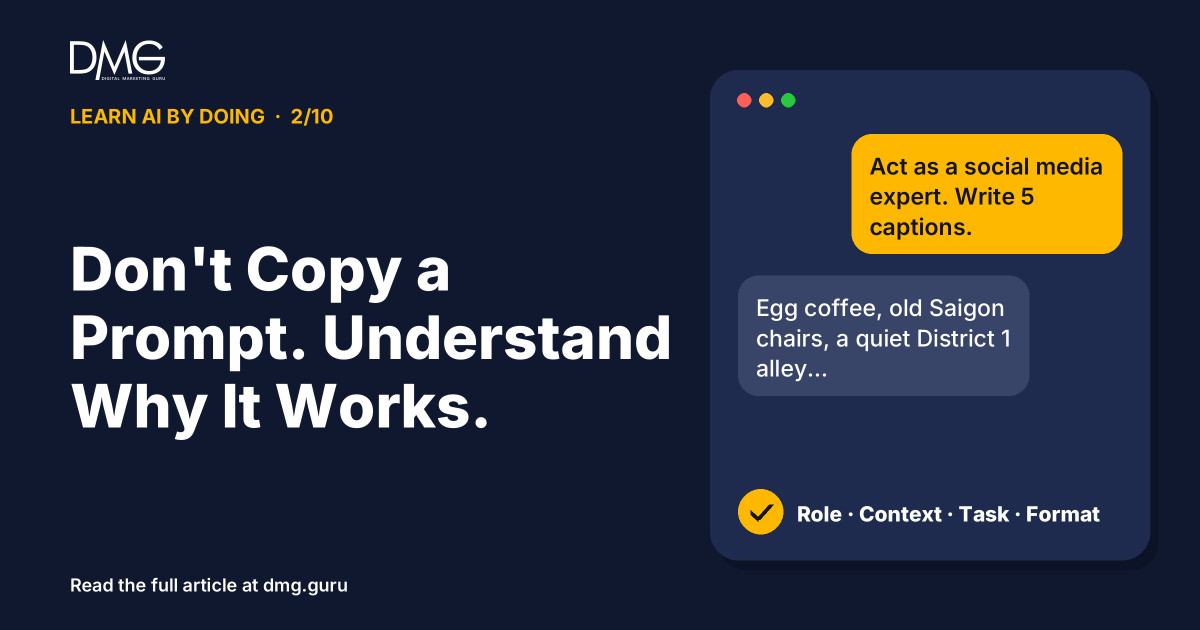
Two coffee shop owners in Ho Chi Minh City see the same viral prompt: “Act as a social media expert. Write 5 engaging Instagram captions for my coffee shop.”
Owner A pastes it in as it is. She gets five captions full of phrases like “Rise and grind” and “Your daily dose of happiness”. They could be for any coffee shop in the world. She posts one, gets twelve likes, and decides AI captions don’t work.
Owner B looks at the prompt and asks a different question: why would this work? She notices it has a role (social media expert) and a task (five captions), but nothing about her shop. So she adds it: her shop is in a quiet alley in District 1, known for egg coffee and old Saigon furniture, popular with students studying in the afternoon. She wants captions in Vietnamese, short, a little nostalgic, each ending with a question.
Her captions mention the alley, the egg coffee, the afternoon light. Regulars comment and tag friends. Same prompt idea, completely different result, because she understood what the prompt was missing.
The four parts of a good prompt
When you take apart prompts that work, you find the same four parts again and again:
- Role: who the AI should act as. “You are an experienced customer service lead for a family-run spa.” The role sets the level of expertise and the point of view.
- Context: what it needs to know. Your customers, products, prices, policies, history, what you’ve already tried. This is the part copied prompts almost always leave out, and it matters most.
- Task: exactly what you want done. Not “help with marketing” but “write a reply that apologises, explains our refund policy in one sentence and offers a rebooking.”
- Format: what the result should look like. Length, language, tone, structure, channel. “Under 120 words, warm but professional, in Vietnamese, ending with our hotline.”
A useful test: if a smart new employee got your prompt as their only instruction, could they do the job well? If not, the AI can’t either.
How to take a prompt apart
Next time you see a prompt you like, don’t save it. Dissect it with four questions:
- Role: who is the AI pretending to be? Does that role fit your business and customers?
- Context: what does the prompt assume the AI already knows? What’s the equivalent information for your business?
- Task: is this the task you actually need, or something close to it?
- Format: does the length, tone and structure suit your channel, whether that’s Zalo, Facebook, email or a printed menu?
Then rebuild it with your own answers. You’ll often find the original prompt was mostly role and task, and the real power came from context the author had in their head but never shared.
Before and after: a real rewrite
Copied version: “Write a follow-up email to a potential client.”
Understood version: “You are the owner of a small interior design studio in Thu Duc. Last Tuesday I met a couple who just bought a 2-bedroom apartment and want a modern, warm style on a budget of around 300 million VND. They liked our past project photos but were worried about timeline because they move in 10 weeks. Write a short follow-up email in English that thanks them, addresses the timeline concern with our usual 8-week process, and suggests a 30-minute call this week. Friendly, confident, no pressure, under 150 words.”
The second prompt is longer, but it takes two minutes to write and produces an email you’d actually send. That’s the trade: a little more thinking up front, much less editing after.
Common mistakes
- Collecting instead of understanding. A folder of 200 saved prompts is less useful than understanding one prompt deeply.
- Trusting “magic words”. Phrases like “act as a world-class expert” help a little. Clear context helps a lot.
- Leaving out the customer. The more you describe who the message is for, the better it fits them.
- Forgetting the format. A great answer in the wrong length or language still needs rewriting.
Practise this week
Take one prompt you’ve saved, or one from a post you liked. Run it exactly as written on a real task. Then rewrite it using role, context, task and format with your own business details, and run it again. Put the two answers side by side.
The difference between them is exactly what understanding adds. Once you’ve seen it with your own eyes, you’ll never look at a prompt list the same way again.
Frequently asked questions
Are prompt templates useless?
No. They’re useful examples of structure and ideas. Treat them like a recipe you adapt to your own kitchen, not a meal you reheat.
How long should a prompt be?
As long as it needs to be for a new employee to do the job well. Simple tasks need two or three sentences; important customer messages or reports deserve a full paragraph of context.
Do I need to write all four parts every time?
No. Once you’ve written your business context once and saved it (in a project, a note or your AI tool’s memory), most daily requests only need the task and the format.
Next in the series: Start With Your Business Problem, Not the AI Tool. Tomorrow: why the question “what can this AI do?” leads you the wrong way, and the better question to ask.
Learn AI by Doing, part 2/10.
Follow DMG on Google: add dmg.guru as a preferred source
Related articles
 How can you tailor your digital mentoring for different preferences?
 Your Best Salesperson Is Hiding Your Marketing Problem
 Stop Copying Text. Ask Claude for the File.
 Discounts Don’t Build Loyalty. They Teach Customers to Wait.
 Unlocking Growth: The Essential Guide to Modern Digital Marketing
 Marketing is facing a turning point