Key takeaways
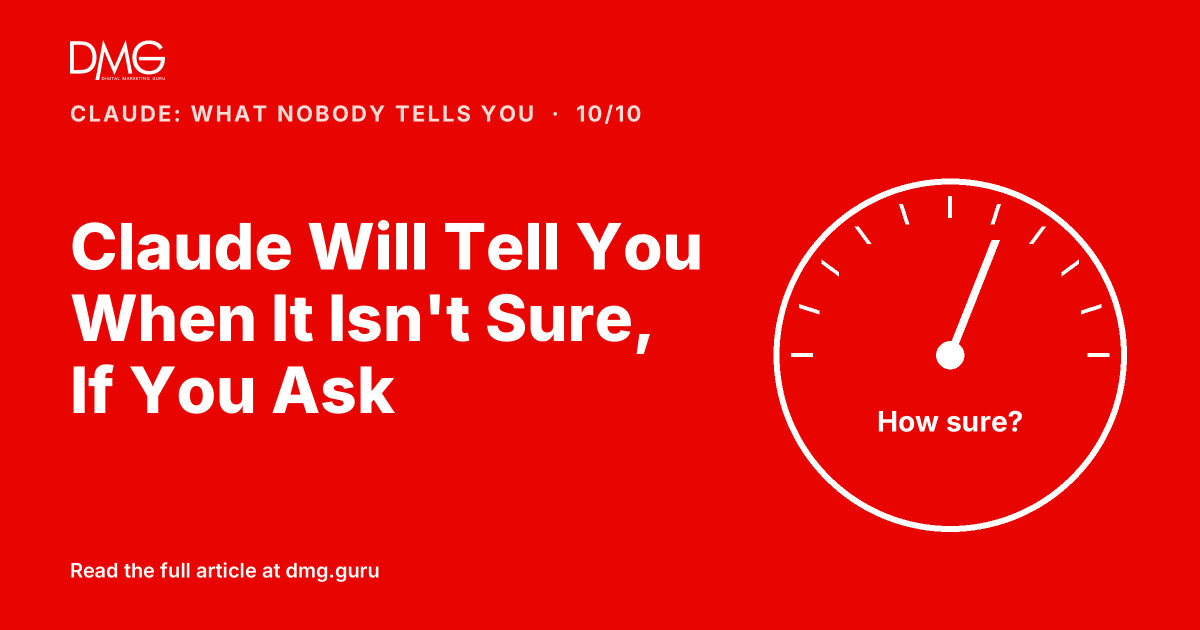
- Claude’s tone doesn’t tell you how sure it is. A guess and a well-supported answer can read the same.
- Anthropic’s own guidance says explicitly allowing Claude to say “I don’t know” reduces made-up answers.
- Before acting on an important answer, ask for its assumptions, the strongest counter-argument, and what would make it wrong.
Contents
Ask Claude whether a price increase will hurt your sales and you’ll get a clear, well-written answer. It may be right. It may also rest on three assumptions about your customers that nobody checked. The writing looks the same either way.
Why confidence isn’t a signal
Claude is built to give helpful, fluent answers. Fluency isn’t certainty. When information is missing, a model can fill the gap with something plausible, and the sentence that contains a guess sounds just as calm as the sentence that contains a fact. On top of that, as we covered in Your AI Agrees With You. That’s the Problem., AI tends to lean towards the view you bring to it.
The good news: Claude is quite willing to show its uncertainty. You just have to ask.
Four questions that change the answer
- “You’re allowed to say you don’t know.” Add it to important questions. Anthropic’s guidance on reducing made-up answers recommends exactly this.
- “List the assumptions behind this answer.” You’ll often find one that’s wrong for your business, such as your customers being price-sensitive when they aren’t.
- “Give me the strongest argument against your recommendation.” If the counter-argument is better than the recommendation, you’ve learned something.
- “What would make this wrong?” This turns an opinion into something you can check: “this fails if more than 30% of your sales are repeat customers.”
When to use them
Not for a caption. Use them when the answer will cost money or be hard to undo:
- Pricing and budget decisions
- Choosing a supplier, a platform or a hire
- Anything legal, tax or compliance related (then check with a professional)
- Numbers that go to a client, a bank or your accountant
For facts that may have changed recently, combine this with web search and sources, as we covered in part 3 of this series.
The series in one line
Across these ten articles, the pattern is the same: Claude is far more capable than the way most people use it, and the gap is closed by habits, not tricks. Give it context, check what it remembers, control your data, ask for files, connect your tools, write your Skills, pick the right model, and make it show its doubts.
Frequently asked questions
Does Claude make things up?
It can, especially when information is missing. Allowing it to say “I don’t know”, asking for sources and asking for its assumptions all reduce the risk.
How do I know if Claude is sure?
Not from its tone. Ask it directly how confident it is, what it’s assuming, and what would make the answer wrong.
Should I trust Claude for business decisions?
Use it to think faster and see more options, then check the assumptions behind the answer before you act, especially on money, legal or compliance matters.
Next step: See where your marketing really stands with DMG’s Full Business Audit.
Want help setting up Claude for your team? Talk to DMG.
Claude: What Nobody Tells You, part 10 of 10. Facts checked against Anthropic’s guidance on reducing hallucinations on 13 November 2026.
Follow DMG on Google: add dmg.guru as a preferred source
Related articles
 Boosting Your Bottom Line: How to Optimize Your Sales Process for Better Paid Ad ROI
 “What % of Revenue Should I Spend on Marketing?” Is the Wrong Question
 Marketing is facing a turning point
 Stop Copying Text. Ask Claude for the File.
 One Long Chat Makes Claude Work Harder for Less
 How can you help a franchise develop a brand identity that stands out?