Key takeaways
- Claude’s answers are only as specific as the context you give it. A one-line question gets a generic answer.
- Projects let you give Claude your business context once: standing instructions plus files such as your price list, service menu and customer FAQ.
- Projects are available on every Claude plan, including Free (up to five projects), and project files count less against your usage limits when reused.
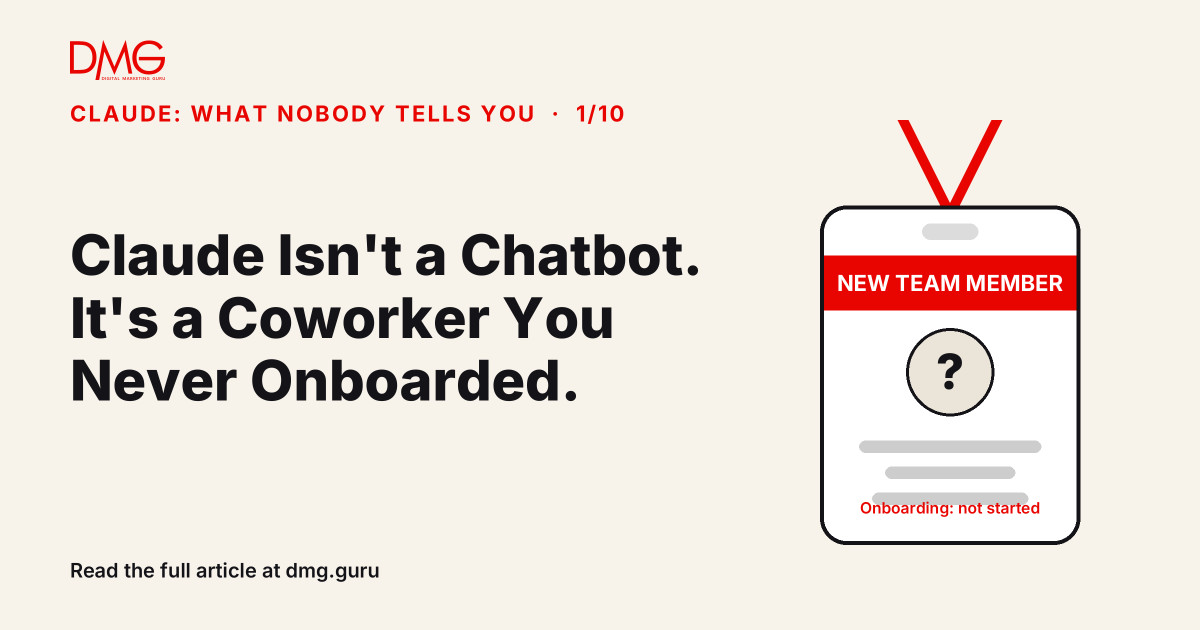
A new staff member joins your company. On day one, you don’t tell them anything: not who your customers are, not your prices, not how you talk to people. Then you ask them to write a sales message and complain that it sounds generic.
That is how most business owners use Claude.
Why the answers feel generic
Claude knows a great deal about marketing, sales and writing in general. It knows nothing about your business unless you tell it. When you type “write a Facebook post for my spa”, Claude has to guess everything else: your district, your customers, your prices, your tone. A guess built on averages produces an average post.
The problem isn’t the tool. It’s the missing onboarding.
What onboarding Claude looks like
Claude has a feature built for this: Projects. A project is a workspace with two things every chat inside it can use:
- Instructions. Standing rules, written once. For example: “You write for a nail and hair spa in District 1. Our customers are office workers aged 25–40. We never discount below 15%. Write in a warm, short, friendly tone.”
- Project knowledge. Files Claude reads as background: your price list, service menu, the questions customers ask most, a few of your best-performing posts.
Every new chat in that project starts with this context already in place. You stop re-explaining your business every morning.
Things nobody mentions
- It’s not a paid-only feature. Projects are available on every plan. Free users can create up to five.
- It saves usage. Anthropic says content in projects is cached and counts less against your limits when reused. Uploading your core documents once is cheaper than pasting them into every chat.
- It scales. On paid plans, when project knowledge gets large, Claude switches to a retrieval mode that Anthropic says expands capacity by up to 10 times.
- Teams can share it. On Team and Enterprise plans, a project can be shared with colleagues, so everyone works from the same instructions and files.
A one-hour setup
- Create one project named after your business.
- Write instructions in plain language: who you serve, what you sell, your tone, your rules (prices you never break, words you never use).
- Upload three documents: your price list or service menu, your 20 most common customer questions with your answers, and five posts or messages that worked.
- Ask the same question you asked before, inside the project, and compare.
Keep separate projects for separate jobs: one for marketing content, one for customer replies, one for a specific client or campaign.
The point
Claude doesn’t replace knowing your business. It multiplies what you give it. Give it nothing, and you get an average stranger. Give it your context, and you get something much closer to a trained team member.
Frequently asked questions
What is a Claude Project?
A workspace inside Claude with standing instructions and uploaded files (project knowledge). Every chat in the project uses that context, so you don’t have to repeat your business background each time.
Are Claude Projects free?
Yes. Projects are available on all plans. Free users can create up to five projects; paid plans add more capacity for large project knowledge.
What should I upload to a Claude Project?
Start with your price list or service menu, your most common customer questions with your answers, and a few examples of posts or messages that worked. Add brand rules and tone of voice in the instructions.
Next step: See where your marketing really stands with DMG’s Full Business Audit.
Want help setting up Claude for your team? Talk to DMG.
Claude: What Nobody Tells You, part 1 of 10. Facts checked against Anthropic’s help pages on 13 November 2026; features and plans may change.
Follow DMG on Google: add dmg.guru as a preferred source
Related articles
 Your Website Isn’t Ugly. It’s Silent.
 Claude Doesn’t Know What Day It Is
 Grok Reads X. Gemini Reads Google. Claude Reads Your Documents. None of Them Read Your Bank Account.
 Discounts Don’t Build Loyalty. They Teach Customers to Wait.
 Boosting Your Bottom Line: How to Optimize Your Sales Process for Better Paid Ad ROI
 How can you adjust your display ad bidding strategy for a competitive landscape?