Key takeaways
- Starting with a tool leads to impressive experiments that change nothing in your business.
- Start with a problem that repeats, costs you time or money, and has a result you can check.
- One well-chosen problem, solved properly, teaches you more about AI than ten demos.
Contents
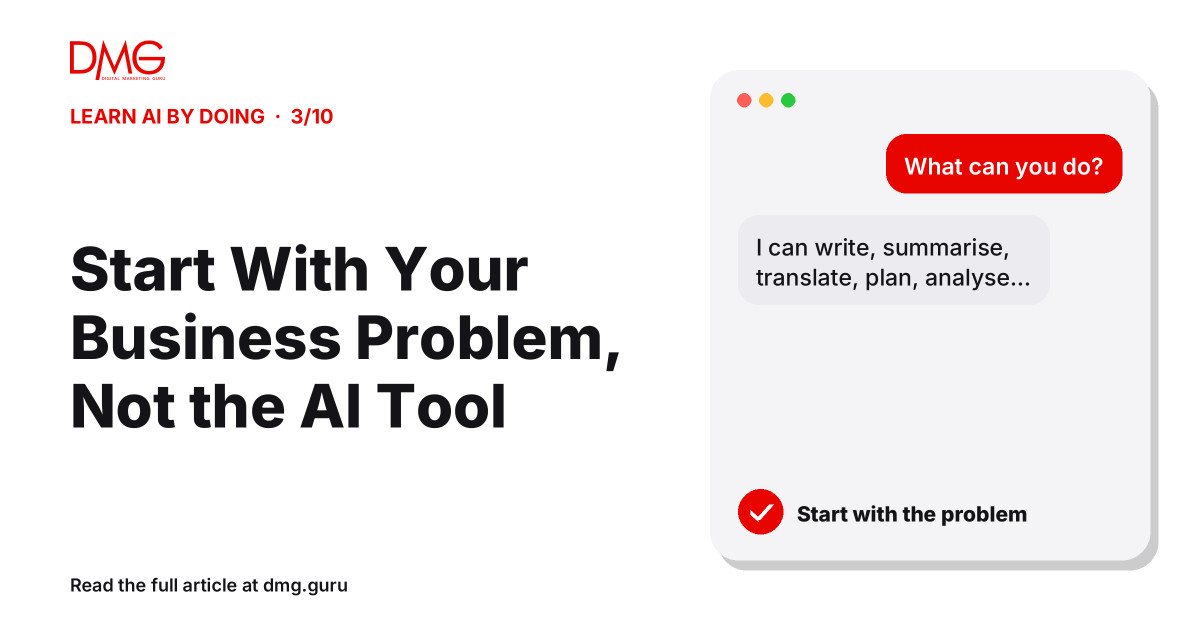
Most people meet a new AI tool the same way: they open it, look at the empty box and ask, “What can you do?” The answer is always some version of “a lot”: write, summarise, translate, analyse, brainstorm, plan. Exciting, but not useful. An hour later you’ve generated a poem about your brand, a logo idea and a business plan you’ll never read, and nothing in your business has changed.
This is the tool-first trap. It’s the reason many owners say “I tried AI, it was interesting, but I don’t really use it.”
Why tool-first doesn’t last
When you start from the tool, you test what the tool is good at. When you start from the problem, you test whether AI helps your business. Only the second one changes your results.
There’s a second reason. A problem you actually care about gives you something to measure. You know how long it takes now, how good the result needs to be and what a mistake would cost. That gives you a fair way to judge the AI, instead of being impressed or disappointed based on a demo.
The “annoying list” exercise
Here’s a simple way to find your first problem. For one week, keep a note on your phone. Every time something annoys you, slows you down or makes you think “why am I doing this again?”, write it down. Don’t filter it.
By Friday most owners have 10 to 20 items. Things like:
- Answering the same five questions on Zalo and Facebook every day.
- Writing product descriptions for new stock.
- Turning messy meeting notes into tasks for the team.
- Chasing customers for reviews after a service.
- Preparing a weekly sales summary from a spreadsheet.
- Translating posts between Vietnamese and English.
That list is worth more than any “top 10 AI tools” video, because every item on it is real.
How to choose your first problem
From your list, pick one problem with three features:
- It repeats. It happens daily or weekly, so even a small improvement adds up over a year.
- It costs something. Time, money, slow replies, missed customers or mistakes that annoy people.
- You can check the result. You know what good looks like, so you can judge the AI’s work quickly and fairly.
Avoid, for now, problems that are rare, highly sensitive or impossible to check, such as legal contracts or a major pricing decision. Those come later, once you understand how AI behaves.
Example: a furniture shop in Binh Thanh
A small furniture shop adds 15 to 20 new products a month. Each needs a product description for the website and Facebook. The owner writes them late at night and admits they’re all starting to sound the same.
She doesn’t start by asking “what can AI do for my shop?” She starts with one problem: product descriptions take about 3 hours a month and she isn’t happy with the quality.
She writes a short brief: who her customers are (young couples furnishing first apartments), her tone (warm, practical, no exaggeration), what every description must include (size, material, care, which room it suits) and two descriptions she’s proud of as examples. Then she tests it on five new products.
Result: three are usable after small edits, two need more work because the AI guessed materials she hadn’t given it. She learns to always include the material list. By the next month, descriptions take under an hour and read better than before.
Notice what happened. She didn’t learn “AI tools”. She learned how AI handles her products, what it needs and where it guesses. That knowledge transfers to everything she tries next.
Turn the problem into a small test
Write one sentence: “We spend [time] every [week/month] on [task], and a good result is [description].”
Then try AI on that task three times over the next week. After each try, note two things: how much time it saved, and what you had to fix. After three tries, you’ll have a clear answer: keep going, improve the brief, or move to the next problem on your list.
Mistakes to avoid
- Chasing the newest tool. A new tool doesn’t fix an unclear problem.
- Picking a problem that’s too big. “Grow my sales” isn’t a task. “Reply to price enquiries within 10 minutes” is.
- Judging on one try. Give each problem at least three real attempts before deciding.
- Forgetting the people. If your team does the task today, involve them. They know where the real friction is.
Frequently asked questions
What if I have too many problems to choose from?
That’s a good sign. Pick the one that repeats most often and is easiest to check. Early wins build confidence, and confidence makes you try more.
Should my first problem be something important?
Real, but low-risk. Choose something where a mistake is easy to spot before it reaches a customer, such as an internal summary or a draft you’ll review.
What if AI doesn’t help with my first problem?
That’s still a useful result. Write down why: missing information, a task that needs judgement, or a tool limitation. Then pick the next item on your list.
Next in the series: Your First Bad AI Answer Is Your Best Lesson. Tomorrow: what a weak AI answer is really telling you, and how to fix it in two rounds.
Learn AI by Doing, part 3/10.
Follow DMG on Google: add dmg.guru as a preferred source
Related articles
 How can you tailor your digital mentoring for different preferences?
 Unlocking Growth: The Essential Guide to Modern Digital Marketing
 AI Didn’t Make Marketing Cheaper. It Made Average Free.
 What is #content, and what can it do for you?
 “What % of Revenue Should I Spend on Marketing?” Is the Wrong Question
 The Prompt Is the Strategy, and Most Owners Can’t Write It