Key takeaways
- Watching someone else use AI gives you their result, not your understanding.
- You learn AI the way you learned your business: by doing real work, making mistakes and fixing them.
- One real task a week, done properly, will teach you more than a month of videos.
Contents
It’s 11pm. You’ve just watched your fourth AI video of the week. The presenter typed a few lines, and in seconds the AI produced a marketing plan, a week of social posts and a sales email. It looked effortless. You saved the video, felt a little more prepared for the future, and went to bed.
The next morning, you open the same tool to write a reply to an unhappy customer. You type something similar to what you saw. The answer is polite, long and completely generic. It doesn’t sound like you, doesn’t mention your policy and would probably make the customer angrier. You close the tab and go back to writing it yourself.
If this sounds familiar, you’re not alone. It’s one of the most common experiences we hear from business owners in Vietnam and abroad. The problem isn’t you, and it isn’t the AI. The problem is that watching is not the same as learning.
Why so many people follow instead of try
There has never been more AI content. Every day there are new videos, courses, prompt lists and “10 tools you must use” posts. Many people teach AI, and many more follow along. Very few stop and try it properly on their own work.
That’s understandable. Watching feels productive. It’s comfortable, it costs nothing, and you never get a bad result because you never actually ask for one. But it creates a dangerous illusion: you feel like you know AI, until the moment you need it to do something real.
Why watching doesn’t stick
Think about how you learned to run your business. You didn’t learn pricing by watching someone else set their prices. You learned by setting yours, seeing what customers did, and adjusting. You didn’t learn to handle complaints from a book. You learned from the first difficult customer, and the tenth.
AI works the same way. When you watch a tutorial, you see three things that don’t transfer to you:
- Their context. The presenter knows their own business, audience and goal. The AI’s answer fits them, not you.
- Their edited result. You rarely see the five bad attempts before the good one. Most videos show the final take.
- Their judgment. The most important skill, knowing whether an answer is good, happens silently in their head. You can’t see it on screen.
So you leave with the steps, but not the understanding. And steps without understanding break the moment your situation is a little different.
What learning AI actually looks like
Learning AI properly is simpler than most people expect. It follows five steps, and every one of them happens inside your own business.
- Pick a real task. Something you actually need this week: a customer reply, a product description, a staff schedule message, a short report.
- Give it your context. Tell the AI who you are, who the customer is, what you sell, your tone and your rules. Write it as if you’re briefing a new employee on their first day.
- Read the answer like a manager. Don’t just ask “is this nice?” Ask: is it accurate? Does it sound like us? Would I send this?
- Improve it. Tell the AI exactly what’s wrong and what to keep. Add any information it was missing. Usually two or three rounds is enough.
- Write down what you learned. One or two lines: what made the biggest difference, what you’ll do next time.
That’s it. No special course, no secret prompt. Just real work, done with attention.
A real example: a spa in District 3
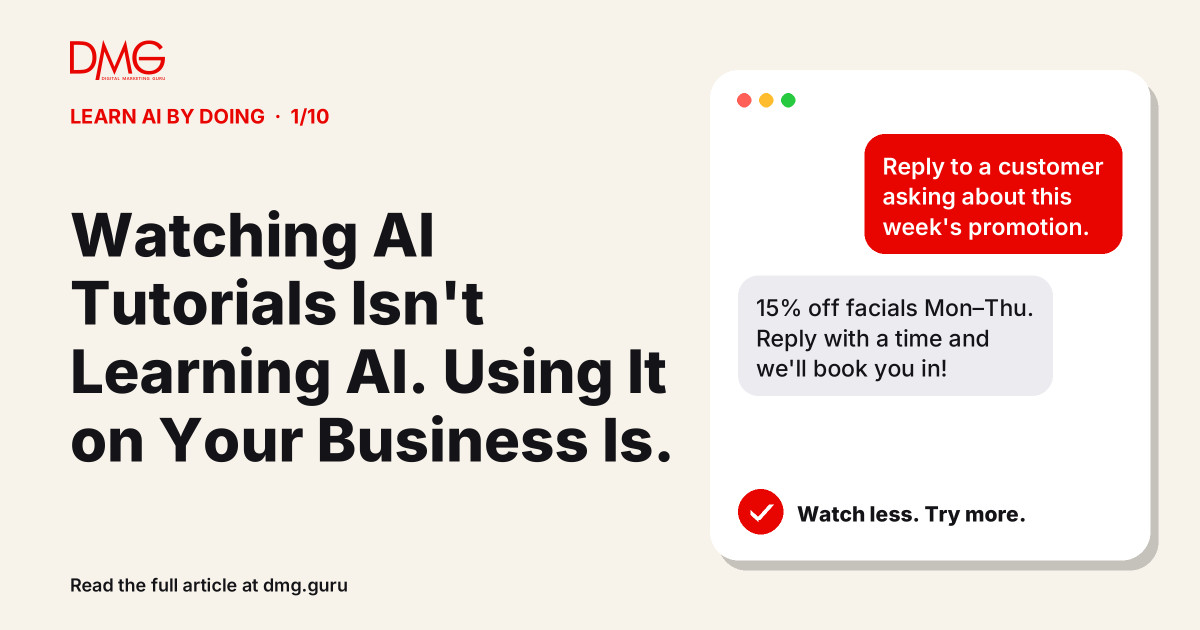
Imagine the owner of a small spa in District 3. She gets the same question on Zalo every day: “Do you have any promotion this week?”
First attempt, copying a tutorial: “Write a reply to a customer asking about promotions.” The AI gives a long, generic answer about “exciting offers” that don’t exist.
Second attempt, with context: “You reply to customers for a small spa in District 3, Ho Chi Minh City. Our customers are office women aged 25–40. This week we have 15% off facials Monday to Thursday only. Reply in friendly Vietnamese, under 60 words, and invite them to book by replying with a time.”
The second answer is short, accurate, sounds like her spa and gives the customer a clear next step. Nothing about the AI changed. What changed was what she gave it, and she only learned that by trying.
After ten minutes, she has something more valuable than a good reply. She understands why the second request worked. She can now apply that to booking reminders, review replies and staff messages without anyone showing her.
Mistakes to avoid when you start
- Starting with something huge. “Write my whole marketing strategy” is too big to judge. Start small and real.
- Giving up after one bad answer. The first answer is a draft. Improving it is where you learn.
- Trusting without checking. AI can sound confident and still be wrong, especially about prices, dates and policies. You stay responsible.
- Only collecting. Saving prompts and videos feels like progress, but nothing changes until you use them on your own work.
A simple start for this week
Choose one task you do every week that takes at least 20 minutes. Do it once with AI, using the five steps above. Then compare: how long did it take, how much did you edit, and would you do it this way again?
You don’t need to be technical. You need to be curious, honest about the results and willing to try again. That’s how every business owner learns anything that matters.
Frequently asked questions
Do I need to be good with technology to learn AI this way?
No. If you can write a clear message to a new employee, you can brief an AI. The skill is explaining your business clearly, which you already do every day.
Are AI tutorials a waste of time?
Not at all. They’re useful for seeing what’s possible. The mistake is stopping there. Watch less, try more, and always test ideas on your own work.
How much time should I spend learning AI each week?
Thirty to sixty minutes on real tasks is enough to make steady progress. Consistency matters more than long sessions.
Next in the series: Don’t Copy a Prompt. Understand Why It Works. Tomorrow we take apart a “perfect prompt” and show you what actually makes it work.
Learn AI by Doing, part 1/10.
Follow DMG on Google: add dmg.guru as a preferred source