Key takeaways
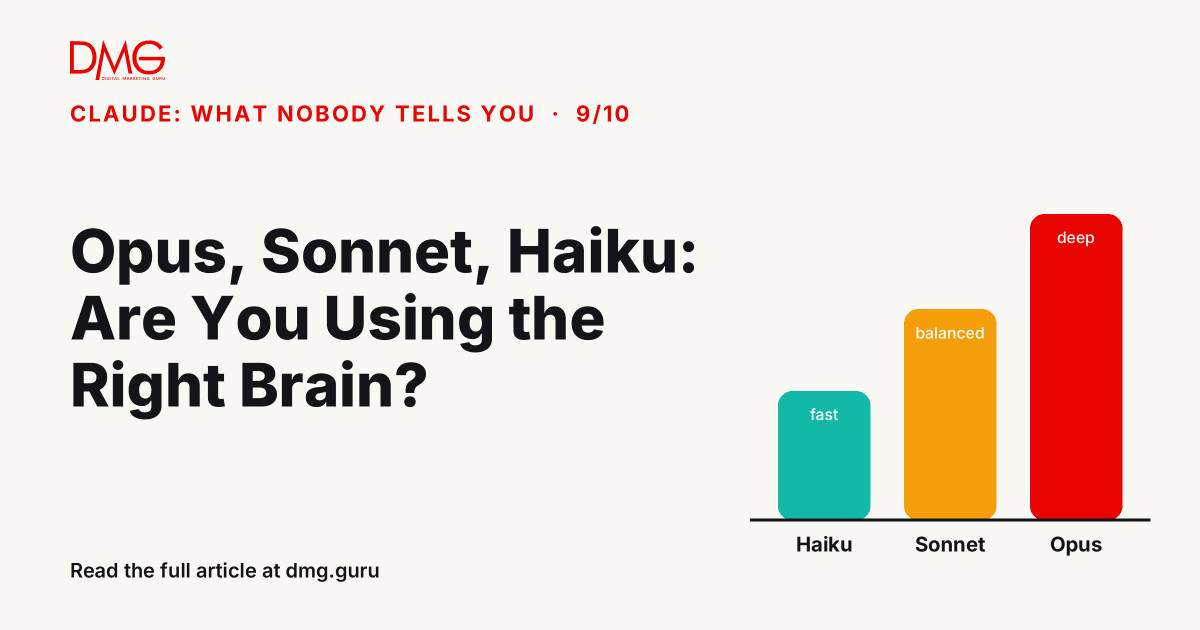
- Claude comes in several models. Haiku is the fastest and uses the least; Sonnet is the everyday default; Opus is for complex reasoning; Fable, on paid plans, is for long, multi-step work.
- Bigger models use more of your usage limit. Using Opus for a quick caption wastes it; using Haiku for a pricing strategy wastes your time.
- The Effort setting controls how much the model thinks before answering. Raise it for hard problems, lower it for routine tasks.
Contents
Most people never touch the model menu. Whatever was selected the first day is what they use for everything, from fixing a typo to planning next year’s budget.
The models, in plain terms
- Haiku: the fastest and lightest. Uses the least of your limit. Good for short, clear tasks.
- Sonnet: the balanced default. Anthropic’s own guidance is to use it if you’re not sure which model to pick.
- Opus: for complex reasoning, careful analysis and difficult writing. Slower, and uses more of your limit.
- Fable: for long-horizon work, tasks with many steps that run for a while. The slowest and uses the most.
The Free plan includes Haiku and Sonnet. Paid plans add Opus and Fable.
Which model for which job
- Haiku: rewriting a sentence, translating a short message, making a list from notes, tidying a caption.
- Sonnet: blog drafts, emails, social calendars, summarising documents, most everyday work.
- Opus: pricing strategy, analysing a competitor’s offer, reviewing a contract’s commercial terms, a proposal for a big client.
- Fable: multi-step research and build tasks, where Claude works through many stages on its own.
The Effort setting
Next to the model, you can set Effort: how much the model reasons before it answers. More effort helps with hard problems and takes longer. For routine tasks, lower effort is faster and lighter on your limit. Think of model as who does the work and effort as how long they think about it.
A simple team rule
- Start every task on Sonnet.
- If the answer is shallow on a hard question, rerun it on Opus or with higher effort.
- If the task is quick and repetitive, switch to Haiku.
Frequently asked questions
Which Claude model should I use?
Start with Sonnet. Use Opus for complex reasoning and important analysis, Haiku for quick simple tasks, and Fable on paid plans for long, multi-step work.
Is Opus always better?
Not for every task. It’s stronger on hard problems, but slower and uses more of your limit. For simple work, Sonnet or Haiku gives the same result faster.
Which models are on the Free plan?
Haiku and Sonnet. Paid plans add Opus and Fable.
Next step: See where your marketing really stands with DMG’s Full Business Audit.
Want help setting up Claude for your team? Talk to DMG.
Claude: What Nobody Tells You, part 9 of 10. Facts checked against Anthropic’s guide to choosing a Claude model on 13 November 2026; models and plans change often.
Follow DMG on Google: add dmg.guru as a preferred source
Related articles
 Your analytics team is struggling to make sense of data. Which data visualization tools can help?
 Claude Isn’t a Chatbot. It’s a Coworker You Never Onboarded.
 Teach Claude Once, Not Every Morning
 Stop Copying Text. Ask Claude for the File.
 “What % of Revenue Should I Spend on Marketing?” Is the Wrong Question
 How do you measure employees or agency digital skills?