Key takeaways
- A weak AI answer usually means something was missing from your request, not that AI can’t help.
- Every bad answer points to a specific fix: more context, a clearer task, an example or a format.
- Improving an answer over two or three rounds is a normal part of working with AI, not a failure.
Contents
Almost everyone has the same first experience with AI. You ask it something important, and the answer comes back bland, too long, slightly off or simply wrong. Maybe it invents a discount you’ve never offered. Maybe it writes in a tone your customers would laugh at. You think: “I knew it. This isn’t for my business.”
That moment decides whether you learn AI or give up on it. The owners who get real value from AI aren’t the ones who got perfect answers. They’re the ones who looked at a bad answer and asked, “What was it missing?”
Think of it like training a new employee
Imagine a new receptionist on their first day. A customer asks about prices, and the receptionist gives a vague, overly formal answer. You wouldn’t fire them on the spot. You’d say: “Our customers like a friendly tone. Here’s the price list. Always offer to book them in.” The next answer is better.
AI is similar, with one big advantage: it doesn’t get tired or offended. You can correct it as many times as you need, and it will try again immediately. The bad answer is simply the start of the conversation.
The five types of bad answer, and what each one means
When AI gives a weak result, it almost always falls into one of these:
- Too generic. It sounds like it could be for any business. Meaning: it doesn’t know enough about yours. Fix: add your customers, offer, location and what makes you different.
- Wrong tone. Too formal, too salesy, too casual. Meaning: you didn’t describe how you speak. Fix: describe your tone, or paste a message you wrote that you like.
- Wrong facts. Invented prices, dates, policies or features. Meaning: it filled gaps with guesses. Fix: give the real facts and tell it to use only what you provided.
- Wrong shape. Too long for Zalo, too short for an email, bullet points when you wanted a paragraph. Meaning: you didn’t specify format. Fix: give length, language and structure.
- Wrong task. It answered a different question. Meaning: the request was ambiguous. Fix: restate exactly what you want and what a good result looks like.
Once you can name which type you’re looking at, the fix is usually obvious.
A worked example: replying to a bad review
A restaurant owner in District 7 gets a two-star Google review: the food was good, but the customer waited 40 minutes on a busy Saturday.
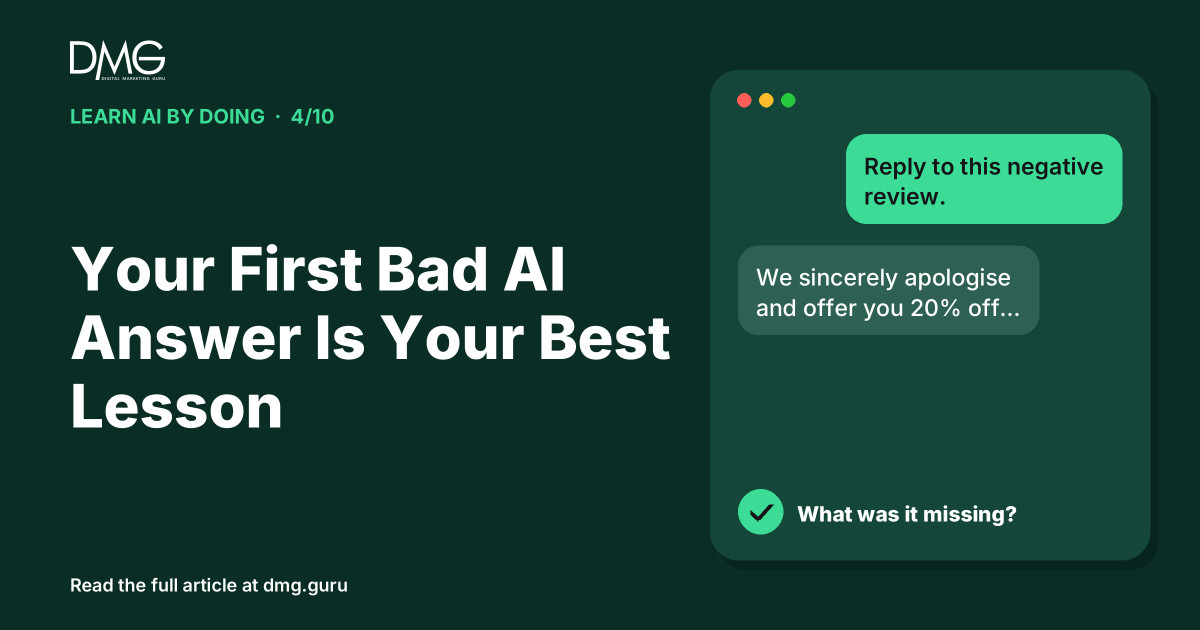
Round 1: “Write a reply to a negative review.” The AI writes a long, formal apology that promises “to review our processes” and offers a discount. Problems: too generic, wrong tone, and an invented discount.
Round 2: She adds context: “We’re a family Vietnamese restaurant. The customer liked the food but waited 40 minutes last Saturday because two staff were sick. We don’t offer discounts in reviews. Our tone is warm and honest. Reply in English, under 80 words.” Much better, but it sounds a little stiff.
Round 3: “Good. Make it sound more personal: thank them for mentioning the food, explain briefly without excuses, and invite them back on a weekday when it’s calmer. Keep everything else.”
The third version sounds like her. More importantly, she now knows what her review replies need every time: the real reason, her tone, no discounts, a specific invitation. She saves that as a short note and never starts from zero again.
How to fix an answer step by step
- Name the problem in plain words. “This is too formal.” “You invented a promotion.” “This is three times too long.”
- Add the missing piece. The real price, an example of your tone, the customer’s exact message, your policy.
- Say what to keep. “Keep the opening line and the structure.” Otherwise the AI may rewrite everything and lose the good parts.
- Ask again, specifically. One clear instruction beats five vague ones.
- Note the lesson. Write one line: what was missing, so you include it next time.
Look for your personal pattern
After five or six tasks, look back at your notes. Most people find their bad answers come from the same one or two causes. Some always forget to describe the customer. Others never give a word limit. Some never say which language to reply in.
That pattern is personal to you, and fixing it once improves every request you make after that. This is what real AI skill looks like: not memorised prompts, but knowing your own blind spots.
Mistakes to avoid
- Starting a new chat after every bad answer. You lose everything the AI learned in that conversation. Correct it instead.
- Saying only “try again” or “make it better”. The AI doesn’t know what “better” means to you. Be specific.
- Accepting a confident answer without checking. A smooth, well-written answer can still contain wrong facts.
Frequently asked questions
How many rounds should it take to get a good answer?
For a new type of task, two or three rounds is normal. If it regularly takes more, your first request is probably missing key context.
Should I keep correcting or start a new chat?
Keep correcting while you’re working on the same task. Start a fresh chat for a new task, and bring a short summary of what you learned.
Can I ask the AI what information it needs?
Yes, and it’s one of the most useful habits you can build. Ask: “Before you answer, what information would help you do this better?” Its questions show you exactly what context matters.
Next in the series: A 30-Minute AI Exercise for Business Owners. Tomorrow: a step-by-step session you can do in your lunch break, on your own work.
Learn AI by Doing, part 4/10.
Follow DMG on Google: add dmg.guru as a preferred source
Related articles
 What are the best tactics for building rapport with a potential client over the phone?
 AI Didn’t Make Marketing Cheaper. It Made Average Free.
 Creator Economy Trends for Influencer Marketing
 AI Lets You Make Mistakes 10× Faster
 Claude Doesn’t Know What Day It Is
 Start With Your Business Problem, Not the AI Tool